No, Speed Didn't Help Our Case
By Sidoc Haytu
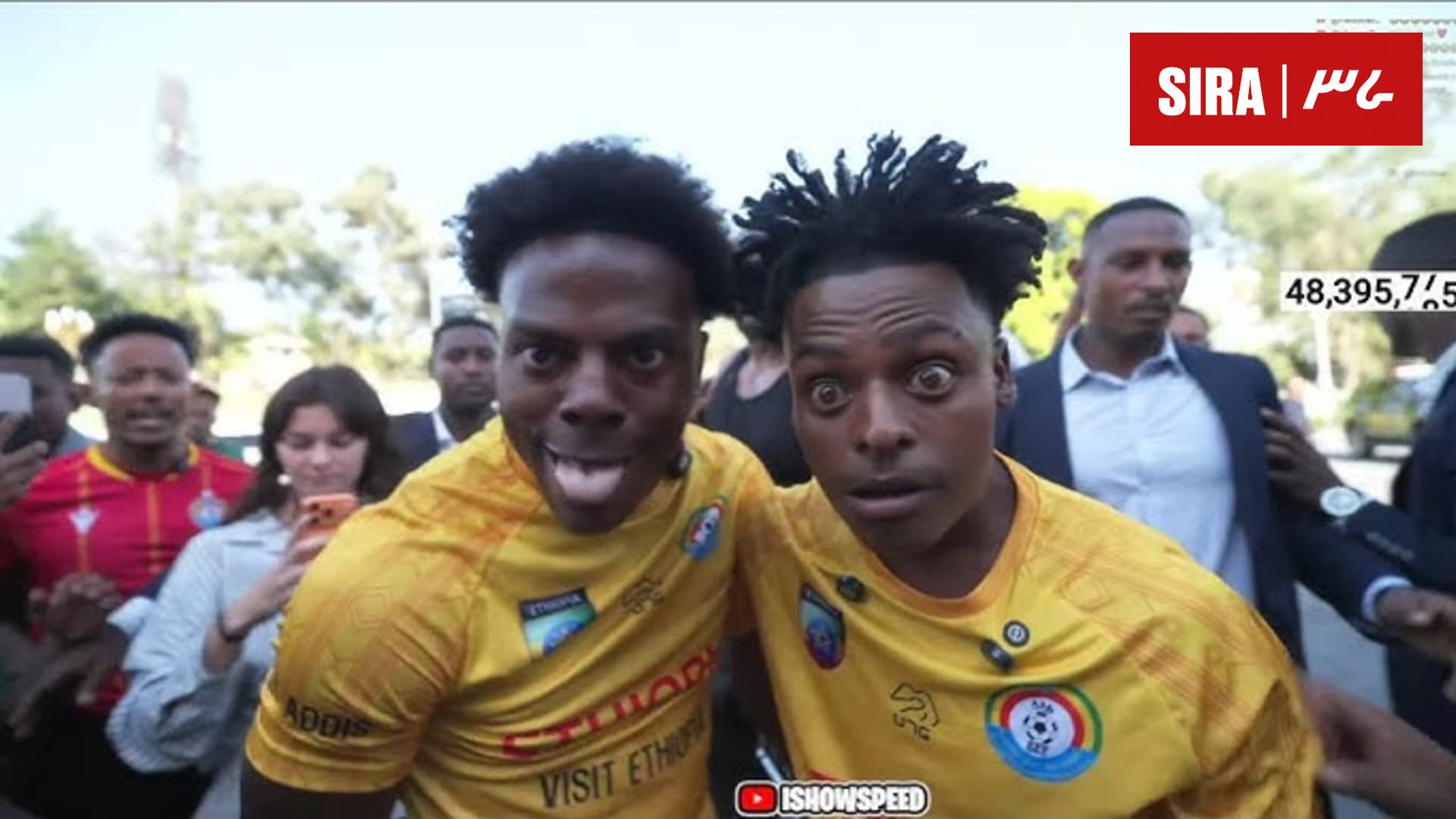
On January 13th, 2026, IShowSpeed's stream from Addis Ababa passed 9.9 million views and peaked at roughly 257,000 people watching live — the biggest single day of his entire 28-country Africa tour. Ethiopians flooded TikTok and X. The Ministry of Tourism showed up in person and handed him a gold bracelet. For one afternoon, it genuinely felt like the whole world was finally looking at us and liking what it saw.
I want to ask you to sit with a harder question than "did it feel good." Ask what, exactly, the world was shown — and who decided.
What actually happened, and who arranged it
Speed's route through Addis wasn't spontaneous. Behind the "unscripted" street energy, a local team spent more than two months assembling the stops: the Ethiopian Science Museum, the Adwa Victory Memorial, Holy Trinity Cathedral, Meskel Square, and time with the Tourism Minister herself and a Miss World runner-up. Even Ethiopian outlets covering it noticed the shape of it. One analysis put it plainly: local critics felt the stream prioritized industrialized areas and famous figures over the reality most citizens actually live in, calling it more of a PR and diplomatic win than a full representation of the country. The same coverage even gave it a name: content diplomacy.
That's the honest term for what this was. Not a documentary. A managed state visit that happened to be filmed on a phone instead of held behind closed doors.
Now hold that image next to what didn't make the stream. No stop at a school where the entrance exam recently failed 87 percent of the half-million students who sat it. No detour through a currency market where a government audit had just found 98 billion birr quietly siphoned out of public funds. No mention of the National Dialogue quietly negotiating away the constitutional rights of entire nationalities, or the insurgencies still burning in Amhara and Oromia while the cameras pointed at a robot exhibit and a museum gift shop.
None of that is Speed's fault, personally. He's a 20-year-old entertainer running a business, and nobody should pretend otherwise. But a government that spent two months curating exactly which parts of Ethiopia got 9.9 million views, and which parts got none, wasn't doing tourism promotion. It was doing image laundering, live, in real time, with global reach it could never have bought from a PR firm.
The other side of the same coin
Compare that to the backlash a different creator faced for going in the opposite direction. When MrBeast released a video building a hundred wells across Cameroon, Kenya, Somalia, Uganda and Zimbabwe, critics tore into it as poverty tourism and "white savior" content — Washington Post writer Taylor Lorenz accused him of monetizing "kindness" in ways some vulnerable people found exploitative, and plenty of others called it worse.
But notice what actual African commentators, the people the video was supposedly exploiting, said instead. Kenyan activist Boniface Mwangi didn't call the video shameful — he called his own government shameful for letting it happen at all. Journalist Ferdinand Omondi said, plainly, that it was embarrassing a YouTuber had to fund what taxpayer money should have handled years ago. Say what you want about the discomfort of watching that footage — and there's plenty to say — but it did one thing Speed's polished museum tour never risked doing: it pointed a finger at the people actually responsible for the water not already being there.
I'm not asking you to like poverty content. I'm asking you to notice which kind of video actually made a government uncomfortable, and which kind got that same government to personally show up with a gold bracelet.
Why the "nice parts" version is the more dangerous one
Here's the part that should actually worry you, and it has nothing to do with tourism.
Every regime that has ever needed to manage how the outside world sees it has understood the same principle: you don't have to hide the bad news if you can bury it under enough good news. Nobody had to censor a single word about the National Dialogue's push to gut Article 39, the ongoing insurgencies, or the corruption audits that same month — because 9.9 million people were busy watching a science museum and a robot demo instead. The bad news didn't get suppressed. It got outcompeted, on the same platforms, in the same news cycle, by content the government itself helped build.
That's not an accusation against Speed. That's a description of exactly what authoritarian and semi-authoritarian governments have always wanted from foreign media attention: not silence, which draws suspicion, but noise in a more flattering direction. A tyrant doesn't need you to believe everything is fine. A tyrant just needs you distracted long enough that you stop asking who's responsible for what isn't.
The anti-imperialist part almost nobody says out loud
There's a deeper problem underneath the government's PR win, and it has nothing to do with Ethiopia's government specifically. It's about who the entire spectacle actually enriched.
A tour that generated over 120 million views across a continent, that reshaped a Western platform's algorithm around "African-centric content," that pulled hundreds of thousands of new subscribers into one creator's channel in a single day — where did that value actually land? Not in the pockets of the Ethiopians who showed up, danced, sang, and fed a stranger raw meat on camera for free. It landed in ad revenue, subscriber counts, and brand deals belonging to a platform and a creator based thousands of miles away. Ethiopia supplied the culture, the crowds, and the content. Somebody else's business account collected the return.
That is not a new relationship. It's an old one wearing a livestream instead of a shipping manifest — a continent's most valuable export, its people and their lived reality, extracted, packaged, and monetized somewhere else, while the government that opened the door for it walked away with a viral PR win it could never have afforded to buy honestly.
What real solidarity with Ethiopia would actually look like
Not a curated museum tour arranged by a Ministry with an image to protect. Not poverty content that shames a government into a single well without shifting who holds power to prevent the next shortage. Real attention would follow the story the government didn't want followed: the exam that failed 87 percent of its students, the elite currency scheme skimming off an entire generation's wages, the National Dialogue quietly deciding nationalities' futures behind closed doors, the insurgencies still burning while a robot exhibit gets 9.9 million views.
Ethiopians don't need the world to see a "nicer" Ethiopia. We need the world, and ourselves, to see the actual one — the one with real grievances, real corruption, real people fighting for a real say in their own future — because a tyrant only gets away with something for as long as the cameras stay pointed somewhere else.
Speed didn't help our case. He was never asked to. That was always our job.
Sidoc Haytu is an Ethiopian writer and researcher focused on political economy, class dynamics, and anti-imperialist movements in the Horn of Africa. If you are ready to build, not just read, join the movement at https://t.me/SiraPress.


